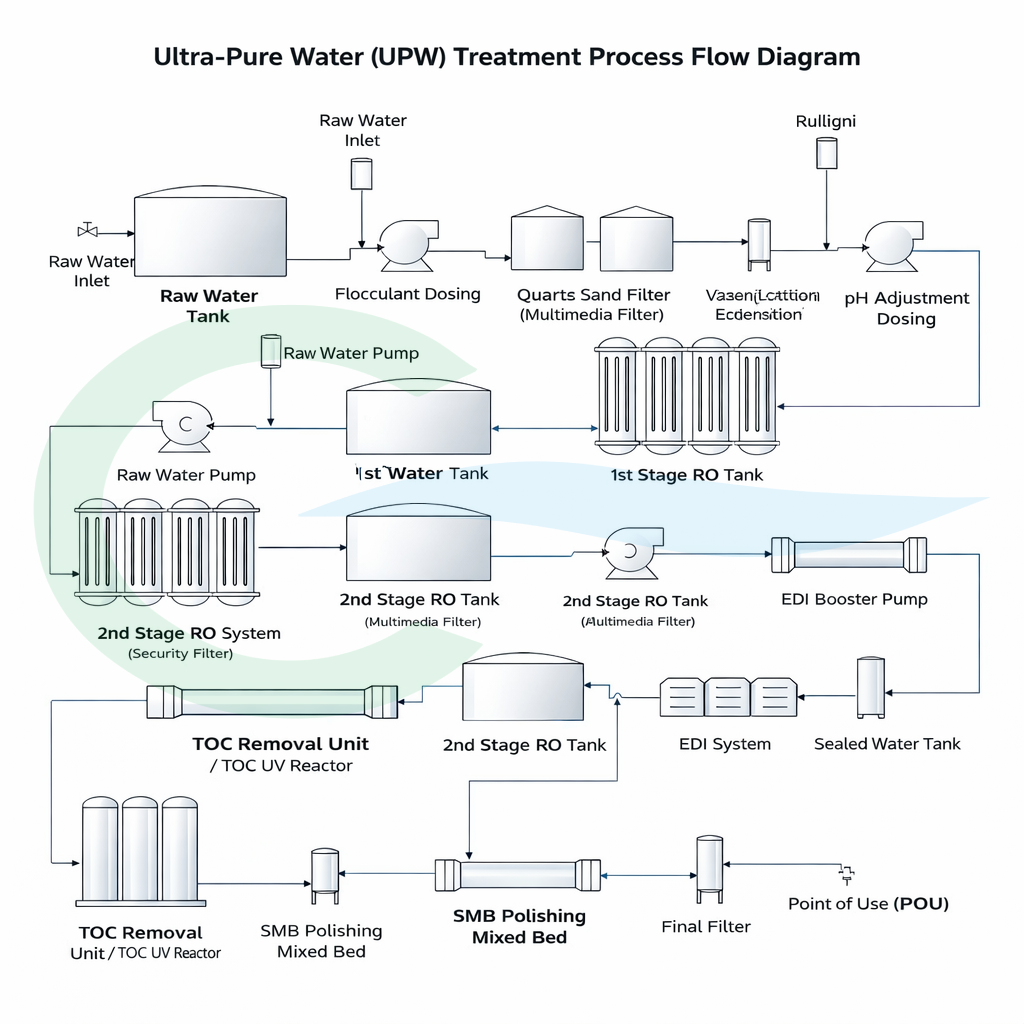
Ultrapure Water Equipment for Polysilicon Wafer Cleaning
The Challenge: Contamination Control in Polysilicon Wafer Cleaning
Polysilicon wafers, used in semiconductor device production, must undergo rigorous cleaning processes to ensure their performance and reliability. Even trace contamination can lead to device failure. The goal of cleaning is to remove surface contaminants, including both organic and inorganic impurities. These contaminants may exist as atoms, ions, thin films, or particles on the wafer surface. Organic contaminants include photoresist, organic solvent residues, synthetic waxes, and oils or fibers introduced by handling. Inorganic contamination, such as heavy metals (gold, copper, iron, chromium), alkali metals (e.g., sodium), and particles (silicon slag, dust, bacteria, microorganisms, and organic colloidal fibers), can significantly affect the wafer’s performance by reducing carrier lifetime, surface conductivity, and causing leakage or defects.
- Organic Contaminants: These include residues from photoresists, organic solvents, and oils or fibers introduced by human handling or tools.
- Inorganic Contaminants: Heavy metals like gold, copper, and iron, and alkali metals like sodium can cause severe electrical leakage and reduce wafer quality.
- Particle Contaminants: These include silicon slag, dust, bacteria, and fibers that can cause defects and reduce the overall yield of the semiconductor devices.
The Conclusion
“In polysilicon wafer cleaning, it is crucial to ensure that all surface contaminants, including organic, inorganic, and particle-based impurities, are completely removed. Using ultrapure water (UPW) in cleaning processes is vital to achieve the required purity levels, ensuring high-performance and reliable semiconductor devices.”
Our Solution: Tailored UPW Process Flows for Polysilicon Processing
We provide two specialized ultrapure water (UPW) cleaning process flows to meet the needs of polysilicon wafer cleaning, based on the specific requirements of the polysilicon processing and local water sources:
- Process 1: ASS + UF + 1RO + 2RO + EDI + SMB
- Process 2: MMF + ACF + 1RO + 2RO + EDI + SMB
- Manufacturing Power: Our advanced design principles ensure that the UPW system consistently meets the required standards, providing high-quality and reliable ultrapure water for the polysilicon wafer cleaning process.
Ultrapure Water for Integrated Circuit Manufacturing
The Challenge: Ensuring Water Purity in Integrated Circuit Production
In integrated circuit (IC) production, ultrapure water (UPW) is crucial for several key processes, with 80% of the steps involving wafer cleaning. The quality of water directly impacts the quality and yield of the final IC products. Contaminants in water, such as alkali metals (e.g., K, Na), heavy metals (e.g., Au, Ag, Cu), group III elements (e.g., B, Al, Ga), and group V elements (e.g., P, As, Sb), can severely affect the performance of the semiconductors. Bacteria and particulates in the water can lead to short circuits or poor electrical characteristics, while specific elements can degrade the properties of both N-type and P-type semiconductors. Maintaining a high level of purity is essential to avoid these detrimental effects and ensure optimal performance.
- Alkali Metals: Elements like potassium (K) and sodium (Na) can weaken the insulating layer and cause poor dielectric breakdown.
- Heavy Metals: Metals such as gold (Au), silver (Ag), and copper (Cu) can degrade the integrity of PN junctions.
- Group III and V Elements: Elements like boron (B), aluminum (Al), and gallium (Ga) can negatively affect N-type semiconductors, while phosphorus (P), arsenic (As), and antimony (Sb) can impair P-type semiconductors.
- Bacteria and Particles: Particles, including bacteria, can adhere to wafer surfaces and cause short circuits or deteriorate the device’s characteristics.
The Conclusion
“The purity of water used in integrated circuit production plays a critical role in ensuring the quality and yield of the final products. Even minor contaminants can significantly impact semiconductor performance. Therefore, utilizing ultrapure water systems is essential to meet the stringent quality standards required for high-performance IC manufacturing.”
Our Solution: Tailored UPW Process Flows for IC Production
To meet the strict water purity requirements for integrated circuit production, we provide the following ultrapure water (UPW) purification process flows:
- Process 1: Ion Exchange – City Water → Source Water Booster Pump → Multi-Media Filter → Precision Filter → Cation Exchange Resin Bed → Anion Exchange Resin Bed → Mixed Bed → Micro-Filter → UPW
- Process 2: Reverse Osmosis + Mixed Bed – City Water → Source Water Booster Pump → Multi-Media Filter → Activated Carbon Filter → Softener → Precision Filter → Stage 1 RO → Intermediate Tank → Booster Pump → Mixed Bed → Micro-Filter → UPW
- Process 3: EDI – City Water → Source Water Booster Pump → Dual Chamber Filter → Softener → Intermediate Tank → Low Pressure Pump → Precision Filter → Stage 1 RO → EDI System → Micro-Filter → UPW
- Manufacturing Power: Our advanced system designs ensure the delivery of ultrapure water meeting the stringent specifications required for IC production, providing consistently high-quality water for wafer cleaning and other critical processes.
Ultrapure Water for Solar Cell Wafer Manufacturing
The Challenge: Purity Requirements in Solar Cell Wafer Production
The production process of solar cell wafers involves multiple stages, including surface texturing, acid etching, diffusion, and the removal of phosphorus silicon glass. Each of these processes requires stringent cleanliness standards to ensure the performance and reliability of the final solar cells. One of the critical steps, the removal of phosphorus silicon glass, involves the use of hydrogen fluoride acid, which reacts with silicon dioxide to form a volatile gas, thereby dissolving the glass. This step, along with others such as diffusion and cleaning, requires ultrapure water (UPW) to remove residual chemicals, particles, and impurities that could impact the final product.
- Phosphorus Silicon Glass Removal: Involves the use of hydrogen fluoride to dissolve silicon dioxide, generating volatile silicon tetrafluoride gas and removing the phosphorus layer from the silicon wafer.
- Cleanliness of Wafers: During various stages, including diffusion and etching, any residual contaminants must be removed to prevent defects in the solar cell performance.
- Process Sensitivity: Even minor contaminants such as metal ions, organic substances, or particulates can affect the quality of the solar cells, making ultrapure water essential at each stage of production.
The Conclusion
“In solar cell wafer production, ensuring the removal of contaminants and impurities is critical for achieving high performance and reliability. Ultrapure water (UPW) is a key element in this process, effectively removing chemicals and particles that could affect the final quality of solar cells. Advanced water purification technologies are essential for maintaining the required cleanliness standards throughout the production process.”
Our Solution: Tailored UPW Process Flows for Solar Cell Wafer Production
To meet the stringent purity requirements for solar cell wafer production, we offer the following ultrapure water (UPW) process flow designed specifically for the cleaning of solar cell wafers:
- Process Flow: Quartz Sand Filter → Activated Carbon Filter → Stage 1 Reverse Osmosis → Stage 2 Reverse Osmosis → EDI System → Polishing Mixed Bed System → UPW
- Efficiency and Reliability: This system combines advanced filtration and membrane separation technologies to ensure that the ultrapure water meets the strict quality standards required for the solar cell manufacturing process.
- System Design: Our ultrapure water system is designed to handle the specific needs of solar cell wafer cleaning, ensuring minimal maintenance and high-quality performance throughout the production process.
Ultrapure Water for Lithium Battery Manufacturing
The Challenge: Ensuring Purity in Lithium Battery Production
In the lithium battery manufacturing industry, ultrapure water (UPW) is essential in multiple stages, including the preparation of electrolyte solutions and cleaning battery components such as the grids for lead-acid batteries. The purity of the water directly affects the performance and safety of the final battery product. Lithium battery production, in particular, requires extremely strict water purity standards to prevent contaminants from affecting the chemical balance and performance of the battery cells.
- Purity Requirements: The water used in battery production must have a conductivity of less than 0.1 µS/cm (resistivity of 10 MΩ), ensuring the absence of impurities like organic and inorganic substances.
- Traditional Methods: Ion exchange systems have been traditionally used, but the need for frequent resin regeneration and maintenance limits their efficiency.
- Advanced Technology: As membrane separation technology improves, reverse osmosis (RO) and mixed-bed deionization (EDI) systems have become common methods for producing ultrapure water in the lithium battery industry.
The Conclusion
“To meet the stringent purity standards required for lithium battery production, ultrapure water (UPW) is a critical factor in ensuring optimal performance, efficiency, and safety of the final battery products. Advanced purification processes like reverse osmosis and EDI systems offer a more efficient, reliable solution compared to traditional ion exchange methods.”
Our Solution: Tailored UPW Process Flows for Lithium Battery Manufacturing
We provide several specialized ultrapure water (UPW) purification process flows designed to meet the high purity requirements of lithium battery manufacturing:
- Process 1: Ion Exchange – City Water → Source Water Booster Pump → Multi-Media Filter → Precision Filter → Cation Exchange Resin Bed → Anion Exchange Resin Bed → Mixed Bed → Micro-Filter → UPW
- Process 2: Reverse Osmosis + Mixed Bed – City Water → Source Water Booster Pump → Multi-Media Filter → Activated Carbon Filter → Softener → Precision Filter → Stage 1 RO → Intermediate Tank → Booster Pump → Mixed Bed → Micro-Filter → UPW
- Process 3: EDI – City Water → Source Water Booster Pump → Dual Chamber Filter → Softener → Intermediate Tank → Low Pressure Pump → Precision Filter → Stage 1 RO → EDI System → Micro-Filter → UPW
- Manufacturing Power: Our system designs incorporate the latest chemical industry requirements, ensuring that the ultrapure water produced meets the strict standards needed for lithium battery production, providing high-quality and reliable performance.
Ultrapure Water for Power Battery Manufacturing
The Challenge: Contamination Control in Power Battery Production
Power batteries, used in electric vehicles, electric trains, e-bikes, and golf carts, are key components that provide the power source for these tools. Unlike the starting batteries used in traditional car engines, power batteries are designed to provide continuous energy. In the production process of power batteries, several steps require ultrapure water (UPW) to ensure quality and efficiency. These processes include the uniform mixing of the positive and negative electrodes, the preparation of the electrolyte, and the final cleaning of the battery after the electrolyte is injected and capped.
In the production process of power batteries, Ultrapure Water (UPW) is essential for:
Anode/Cathode Slurry Mixing: To ensure material purity and prevent conductive interference.
Electrolyte Preparation: To avoid ionic contamination in the chemical formulation.
Final Product Cleaning: Washing after injection and capping to prevent corrosion and ensure seal quality.
- Contamination Risks: Contaminants such as metal ions, organic compounds, and particulate matter can compromise the performance and safety of power batteries.
- Critical Manufacturing Steps: Key stages in battery production, such as electrode mixing, electrolyte preparation, and post-injection cleaning, require ultrapure water to remove any impurities that could affect the battery’s performance.
- Performance Impact: Even small traces of impurities can negatively affect battery efficiency, charge capacity, and overall lifespan, making contamination control crucial.
The Conclusion
“In power battery manufacturing, controlling contamination is essential for achieving high performance, reliability, and safety. Using ultrapure water (UPW) throughout the production process ensures the removal of contaminants, leading to batteries with superior quality and longer life cycles.”
Our Solution: Tailored UPW Process Flows for Power Battery Production
We offer specialized ultrapure water (UPW) cleaning processes designed to meet the rigorous demands of power battery manufacturing:
- Process 1: MMF + ACF + 1RO + 2RO + EDI + SMB
- Process 2: ROC + TGM + 2SMB + UF
- Process 3: HEX + MDG + UV + MF + 2EDI + MB + HEX + MDG + TOC + 2SMBB + 2UF
- Manufacturing Power: Our cutting-edge designs and advanced systems ensure that the ultrapure water process meets industry standards, guaranteeing top-tier performance and efficiency for the power battery manufacturing process.